2026.07.06
Is Gear Tooth Breakage Always a Quality Issue? Four Common Causes Engineers Often Overlook
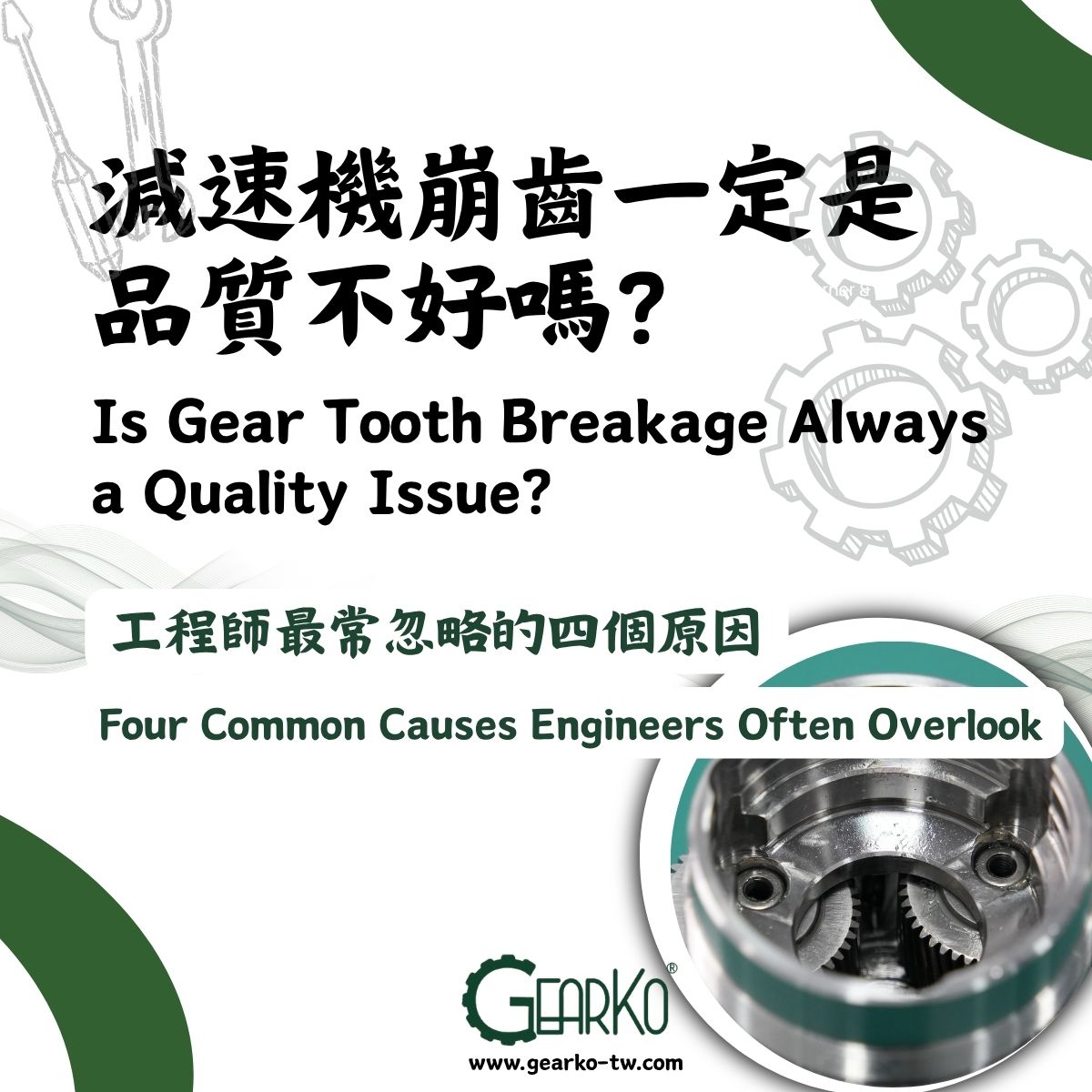
Few failures are more frustrating in automation equipment than gear tooth breakage inside a gearbox.
When a machine suddenly stops operating and inspection reveals chipped, cracked, or broken gear teeth, the first thought is often: "Is there something wrong with the gearbox quality?"
However, real-world cases are rarely that simple.
Through years of supporting customers with gearbox selection and failure analysis, we have found that two machines using gearboxes with identical specifications can experience dramatically different service lives. Some operate reliably for years, while others suffer gear tooth breakage within only a few months.
The difference is not always the gearbox itself. In many cases, the root cause can be traced back to decisions made much earlier in the machine design process.
Quite often, the gearbox is simply the first component to show visible damage, while the real issue lies elsewhere in the system.
Selection criteria, safety factors, inertia matching, installation accuracy, and even machine motion profiles can all influence the actual loads experienced by the gears. Understanding these factors early can help prevent many gear tooth failures before equipment reaches production.
Why Does Gear Tooth Breakage Occur?
From a mechanical design perspective, gear tooth breakage occurs when the stress applied to a gear exceeds its allowable limits.
However, "overload" does not necessarily mean the motor is oversized or the gearbox was incorrectly selected. Many machines are designed according to catalog specifications and operate within rated torque limits, yet still experience gear tooth failures.
The problem often lies in real-world operating conditions that are not reflected in catalog data.
The following are four of the most common causes we encounter in practical applications.
1. Rated Torque Does Not Always Reflect Actual Operating Loads
Many engineers begin gearbox selection by calculating the rated torque of the servo motor. This is a reasonable starting point.
However, rated torque only represents normal operating conditions. It does not account for shock loads that may occur during abnormal events.
Examples include material jams, emergency stops, frequent reversing, and mechanical collisions. These situations can generate torque spikes far exceeding normal operating levels.
Such shock loads may not cause immediate failure, but they can create microscopic fatigue cracks near the gear root. As the machine continues to operate, these cracks gradually propagate until they eventually result in gear tooth breakage.
For applications involving high acceleration, frequent start-stop cycles, or impact loading, maintaining sufficient safety margins is often more important than simply meeting rated torque requirements.
2. Correct Torque Calculations, but Poor Inertia Matching
Some machines perform perfectly during commissioning. Motor current, temperature rise, and torque all appear to be within acceptable limits.
However, once production begins, abnormal vibration, noise, and gear damage may gradually appear.
In many cases, the issue is related to inertia matching.
In a servo system, the motor must do more than generate torque. It must continuously accelerate, decelerate, and position the load accurately. If the load inertia is significantly higher than the motor inertia, the gearbox may experience additional stress during every acceleration and deceleration cycle.
These stresses may not cause immediate failure, but over time they accelerate gear fatigue and reduce service life.
For this reason, gearbox selection should not focus solely on whether the system can move the load. Engineers should also consider whether the system can control the load efficiently and stably.
3. The Problem May Not Be the Design — It May Be the Installation
A common characteristic of many failed gears is uneven wear concentrated on only one side of the tooth surface.
This type of damage is often related to installation accuracy.
Ideally, the entire gear tooth surface should share the load evenly. However, if the motor and gearbox are misaligned, or if installation errors exist between the gearbox and the driven mechanism, uneven load distribution can occur.
As the load becomes concentrated in a smaller contact area, local stress rises rapidly.
The machine may continue operating normally for some time, making the problem difficult to detect during routine inspections. However, as operating hours accumulate, localized wear increases and eventually develops into cracking or gear tooth breakage.
This is why we frequently recommend that customers investigate alignment and installation conditions when diagnosing gearbox failures, rather than focusing solely on the gearbox itself.
4. The Biggest Differences Are Often Hidden Inside
The gearbox market offers countless products that appear similar on the surface. Dimensions, performance specifications, and catalog data may look nearly identical.
Yet their long-term durability can differ significantly.
The reason often lies in factors that users cannot easily see, including gear materials, machining accuracy, heat treatment processes, and quality control procedures.
An ideal gear must achieve a balance between hardness and toughness. Insufficient hardness leads to excessive wear, while excessive hardness without adequate toughness can make the gear more susceptible to cracking under shock loads.
Achieving the right balance between wear resistance and impact resistance has always been one of the key challenges in gear manufacturing.
This is one reason why two gearboxes with similar specifications may deliver very different levels of reliability over time.
If you are interested in learning more about gear heat treatment technologies, we invite you to explore GearKo's technical articles on carburizing, plasma nitriding (ion nitriding), and the comparison between these surface hardening processes. These technologies play a critical role in gearbox performance and service life.
How Can Gear Tooth Breakage Be Prevented?
Based on practical experience, most gear tooth failures can be prevented during the design stage.
Instead of waiting until equipment fails and investigating damaged components afterward, engineers should identify potential risks during development.
When selecting a gearbox, it is important to consider not only torque requirements but also possible shock loads under real operating conditions. Adequate safety factors should always be included.
At the same time, inertia matching between the motor and the load should be evaluated carefully to avoid unnecessary stress accumulation over the long term.
During assembly, special attention should be paid to alignment and installation accuracy to prevent localized overloading caused by uneven load distribution.
Many gearbox failures initially appear to be product-related issues. However, detailed investigation often reveals that the root cause lies in design assumptions or application conditions.
Conclusion: Gear Tooth Breakage Is a Result, Not the Root Cause
When gear tooth breakage occurs, the most important question is not "Which component failed?" but rather "Why did it fail?"
From shock loading and inertia matching to installation accuracy and gear manufacturing quality, every stage of the process can influence gearbox service life.
Therefore, when designing automation equipment, engineers should look beyond price and rated torque specifications. A complete selection and validation process based on actual operating conditions is essential for achieving long-term reliability.
After all, gear tooth breakage is merely the final symptom. The real causes are often hidden within the design details that are easiest to overlook.
Further Reading